 Free plan
Casual 2x4 desk
1524 mm × 533.4 mm × 762 mm
Cut list
| Part | Qty | L × W × T (mm) | Note |
|---|---|---|---|
| Leg | 4 | 723.9 × 88.9 × 38.1 | Step 1: build two side sections with the 88.9 mm leg faces along the desk length. Set the outside front/rear faces 508 mm apart; leg tops finish 723.9 mm above the floor. Square all cuts and predrill joints; use wood glue at frame joints. |
| Longitudinal support — front top / back top / back low | 3 | 1320.8 × 88.9 × 38.1 | Step 2: fit between the legs' inner end faces. Front and rear upper rails finish flush with the leg tops and outside front/rear faces; the lower rear rail's bottom is 203.2 mm above the floor. Use two 63.5 mm pocket-hole screws per end with glue, following the jig's settings for 38.1 mm stock. Ordinary 79.4 mm screws cannot pass through the 88.9 mm leg width and reach these rail ends. |
| Side support | 4 | 431.8 × 88.9 × 38.1 | Step 1: center two supports on each pair of legs, standing on edge between their inner front/rear faces. Upper support tops are flush with the legs; lower support bottoms are 203.2 mm above the floor. Drive two 79.4 mm screws through each leg into each support end with glue. The 431.8 mm cut preserves the full frame depth rather than copying the source's shorter side-support cut. |
| Top cross support | 2 | 431.8 × 88.9 × 38.1 | Step 3: stand on edge between the front and rear upper rails with tops flush under the tabletop. Centers are 450.85 mm from their nearest tabletop ends. Predrill and drive two 63.5 mm screws through each upper rail into each support end with glue. |
| Tabletop board | 6 | 1524 × 88.9 × 38.1 | Step 4: lay six boards flat, edge to edge, for a 533.4 mm deep top with 12.7 mm overhang on all four sides and its upper surface at 762 mm. Fasten each board to both upper side supports and both top cross supports with two 50.8 mm screws per contact. Predrill; keep the outer-board screws over the supporting timber. Glue frame joints, not the top to the frame; allow seasonal movement with clearance in the tabletop fixing holes. Sand exposed edges and finish before use. |
| Framing screw 79.4 mm | 16 | 79.4 × 4.2 × 4.2 | Step 1: four side supports × two ends × two screws, driven through the legs with glue at each joint. |
| Pocket-hole / wood screw 63.5 mm | 20 | 63.5 × 4.2 × 4.2 | Steps 2–3: twelve pocket-hole screws for three longitudinal rails plus eight wood screws for two top cross supports; two per support end, with glue. Buy the appropriate screw type for each joint. |
| Tabletop screw 50.8 mm | 48 | 50.8 × 4.2 × 4.2 | Step 4: six tabletop boards × four supporting crossmembers × two screws. Do not glue the top to its frame or overdrive the screws. |
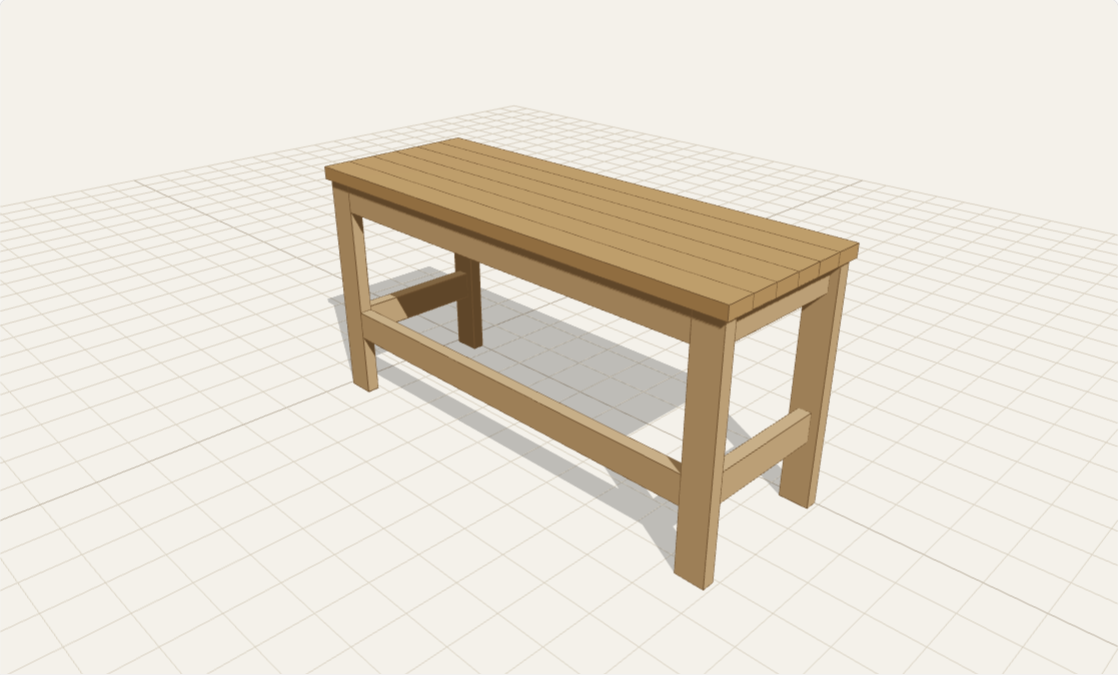
About this plan
A trestle-style desk built entirely from 2x4 construction lumber: two leg frames tied by front and back rails, four side supports, two anti-sag top supports, and a six-board top with a half-inch overhang on every side. All cuts are square. The side supports are screwed through the legs, but the three long rails need pocket-hole screws: a 79.4 mm framing screw cannot pass through the 88.9 mm leg width into the rail ends, so a pocket-hole jig is required. This independently modeled adaptation follows the Casual 2x4 Desk from morelikehome.net's 31 Days of 2x4 Projects series.
Dial the length from 1000 to 1829 mm and the height from 700 to 800 mm; the model, cut list, and screw counts rebuild together. Depth stays fixed at 533 mm so six 2x4s laid flat cover the top edge to edge — no ripping. The configuration link always reproduces exactly what you see.
Questions
- Which dimensions can I change?
- Length and height. The top depth stays 533 mm (21 in) so six full-width 2x4s cover it with the reference's 1/2 in overhang. Longer tops may want a third anti-sag support — the source suggests this too.
- Why are the side supports longer than the original cut list?
- The source lists 13 in side supports, but the leg frame is 17 in front-to-back inside the legs. We cut them 431.8 mm so they span the legs coherently; everything else follows the reference build.
- Do I need pocket holes?
- Yes, for the three long rails. The side supports are screwed through the legs with 79.4 mm framing screws, but that length cannot pass the 88.9 mm leg width into a rail end, so each rail end takes two pocket-hole screws — twelve in total.
- How much lumber should I buy?
- The reference desk uses six 8-foot 2x4s. Your custom length changes rail, top-support, and tabletop cuts — take the live cut list to the store and add kerf and waste before choosing board lengths.
- Does this plan include a CNC file?
- No. Every part is a straight crosscut in 2x4 stock. You get the live cut list plus assembled and exploded 3D views; CNC download controls are intentionally absent.