 Free plan
Craftsman end table
533.4 mm × 533.4 mm × 622.3 mm
Cut list
| Part | Qty | L × W × T (mm) | Note |
|---|---|---|---|
| A — center tabletop board — nominal 2×4 | 2 | 177.8 × 88.9 × 38.1 | Step 1: begin the patchwork with these two boards side by side, their grain running across the table width. All eighteen blanks use actual 38.1 mm × 88.9 mm stock; measure dry, straight lumber, acclimate it, and allow for saw kerfs, jointing, end trimming and defects. These two A boards are 177.8 mm long; at the default width they match the source's 177.8 mm A cuts. Custom width changes only the transverse top cuts, so the center is not necessarily square. Glue only this parallel-grain edge joint. Set the pocket-hole jig for actual 38.1 mm thickness and verify spacing, screw length and penetration on matching offcuts before drilling. |
| A — side tabletop board — nominal 2×4 | 2 | 177.8 × 88.9 × 38.1 | Step 1 continued: fit these two 177.8 mm A boards across the ends of the central pair, one on each side. Their grain runs front to rear. The source glues and pocket-screws the entire patchwork; this introduces cross-grain restraint. Do not rigidly glue or pocket-screw across these end-grain borders. Use fitted floating loose-tenon border joinery with one fixed central reference and sliding outer connections, leaving cross-grain seams unglued. Select tenon size, mortise depth and movement travel for the actual stock, species and moisture range before machining; the butt-to-butt blank lengths remain unchanged. The viewer shows nominal closed seams, not the joinery or seasonal clearances. |
| B — inner tabletop border — nominal 2×4 | 2 | 355.6 × 88.9 × 38.1 | Step 1 continued: fit these two 355.6 mm B boards across the front and rear edges of the A assembly, grain along the table width. At defaults they retain the source's 355.6 mm B length. Then add the two side B boards in the next row. Dry-fit each ring in sequence rather than cutting against an accumulated nominal measurement. Continue the movement-compatible border joinery wherever grain directions cross; do not substitute rigid glue or screws across those joints. Stagger any permitted underside pockets away from neighboring joints and confirm screw trajectories cannot collide or break through an edge. |
| B — side tabletop border — nominal 2×4 | 2 | 355.6 × 88.9 × 38.1 | Step 1 continued: these 355.6 mm side B boards run front to rear outside the inner B pair. Their outside faces establish the full 533.4 mm table width. Keep the top flat and compare both diagonals during the dry fit; correct the assembly before fastening. Border tenons, pockets and movement clearance are machining operations, not extra boards in the ten-piece top or solids in the preview. Cross-grain joints remain floating and unglued. |
| C — outer tabletop border — nominal 2×4 | 2 | 533.4 × 88.9 × 38.1 | Step 1 continued: add these two full-width 533.4 mm C boards at the front and rear. Each covers 88.9 mm of depth; together with the inner field they make the fixed 533.4 mm depth and complete the ten-board patchwork. All top boards finish 38.1 mm thick. Step 3: center the top on the four leg ends with its upper face at 622.3 mm and a 12.7 mm overhang beyond the frame on every side. IMPORTANT DEVIATION FROM SOURCE: do not glue the top to the frame or drive rigid screws down into the legs. Use movement-compatible tabletop clips suited to this raised-top arrangement and its 25.4 mm rail-to-top gap; choose the complete clip system, fixing locations, machining and screw penetration from its manufacturer's instructions. Do not assume a standard apron clip can bridge that gap. Keep both the top's floating border joints and the clip travel free to move. |
| D — leg — nominal 2×4 | 4 | 584.2 × 88.9 × 38.1 | Step 2: cut four identical 584.2 mm legs, retaining the source's 584.2 mm length at the default height. Stand their 88.9 mm broad faces along the table depth and their 38.1 mm thickness across its width. Feet sit on the ground and leg tops directly support the 38.1 mm-thick top. Inset the outer leg faces 12.7 mm from all four tabletop edges; the resulting clear rail spans retain the source's written cuts at defaults. Build two identical side sections on a flat surface. Verify the jig on actual 38.1 mm stock, clamp joints and avoid overdriving or splitting. |
| E — side rail — nominal 2×4 | 2 | 330.2 × 88.9 × 38.1 | Step 2 continued: fit one 330.2 mm side rail between each front/rear leg pair, retaining the source's 330.2 mm side cut. The side rail's outside face aligns with the legs' outside side faces. Set its top 25.4 mm below the leg ends, at 558.8 mm above the floor, with its underside at 469.9 mm. The fixed depth and 12.7 mm tabletop overhang keep this clear span unchanged as width varies. Glue the frame joints and allow two 63.5 mm pocket screws at each end, eight for both side rails. Keep pockets hidden inward and stagger them clear of adjacent front/back-rail screws. |
| F — front/back rail — nominal 2×4 | 2 | 431.8 × 88.9 × 38.1 | Step 2 continued: connect the side sections with these 431.8 mm rails between the legs' inner width faces. Their front/rear outside faces are flush with the corresponding outer leg faces, preserving the source's silhouette, and their tops align with the side rails at 558.8 mm. The default length retains the source's 431.8 mm cut; custom widths change this clear span while keeping the 12.7 mm overhang. Use glue and two 63.5 mm pocket screws per rail end, eight for this pair; confirm hidden pockets clear neighboring screws. Measure diagonally corner to corner in both directions and adjust until the measurements agree before fitting the top. Step 4: fill appropriate holes without blocking movement joints, ease sharp edges, sand, remove dust and apply paint or stain and a compatible protective finish per product instructions. Install suitable anti-tip restraints through solid frame members into wall framing. Baskets and any lower shelf are excluded. Do not sit, stand or climb on the table; no load rating is supplied. |
| Frame pocket-hole screw 63.5 mm | 16 | 63.5 × 4.8 × 4.8 | Procurement allowance, not a source total: two screws at each of eight rail-to-leg joints (four rails, two ends each). The listed 4.8 mm diameter is nominal, not a verified joint specification. Choose thread and head for the actual wood and jig; prove spacing and penetration on offcuts of actual 38.1 mm stock. Stagger intersecting corner pockets and predrill as required. These screws are for the glued base only, not rigid leg-to-top attachments. Procure tabletop joinery and any permitted parallel-grain fasteners separately for the selected joint design; do not rigidly screw across the patchwork's grain directions. Clip-system screws, floating border joinery, glue, finish and anti-tip hardware are separate purchases. Fasteners, pockets, mortises, clips and restraints are not rendered. The source author had not physically built the exact plans, and this adaptation is not a certified structural design. |
About this plan
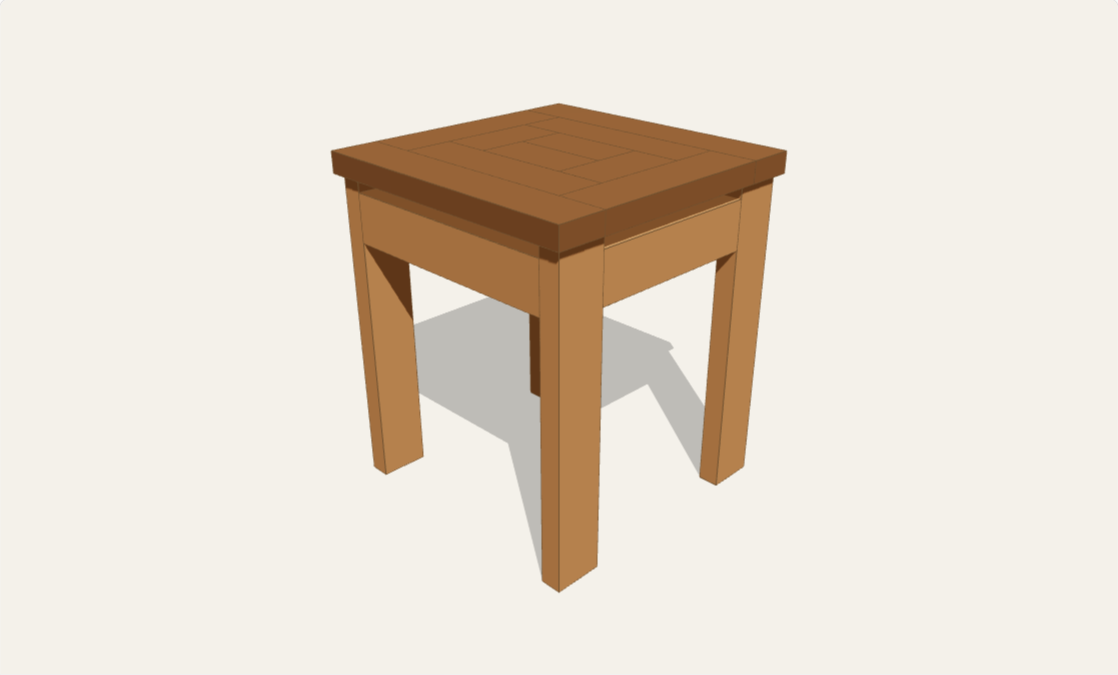
A square end table with a ten-board patchwork top, four legs and a rail apron set 25.4 mm below the leg tops, leaving open space beneath for a basket. All blanks use actual 38.1 × 88.9 mm 2×4 stock. The frame is a pocket-hole build; the alternating-grain tabletop requires experienced joinery work to accommodate wood movement. Allow a weekend or more plus finish curing. It is a lamp-and-book side table, not a seat or step, and carries no load rating. Restrain the table against tipping with suitable hardware into wall framing.
Customize width from 450–700 mm and overall height from 550–700 mm; depth remains 533.4 mm. Defaults preserve every published cut: four 177.8 mm A boards, four 355.6 mm B boards, two 533.4 mm C boards, four 584.2 mm legs, two 330.2 mm side rails and two 431.8 mm front/back rails. The top overhangs the frame by 12.7 mm on all sides. Floating cross-grain border joints and movement-compatible top fasteners replace the source's rigid screws and glue. Joinery details, seasonal clearances and hardware are not rendered; select and verify them for the actual stock before building.
Questions
- Which dimensions can I change?
- Width and height are customizable; depth stays 533.4 mm. Width changes the transverse A, B and C cuts and front/back rails, while height changes the legs. Stock width and side-rail lengths stay fixed. The live preview, cut list and shared link update together.
- Why is there a gap under the top?
- The source sets the rail tops 25.4 mm below the leg ends, producing a visible reveal and an open bay beneath. Baskets must be measured against the configured opening; no shelf or basket is included.
- How is the top assembled and attached?
- This is an alternating-grain patchwork, not one parallel-grain panel. Glue only parallel-grain edges and use floating joinery where borders cross grain. Mortises, tenons and movement allowances must be designed for the actual stock and moisture range. Attach the top using movement-compatible hardware suited to the 25.4 mm gap above the rails; ordinary apron clips may not bridge that gap. Do not rigidly glue or screw the cross-grain borders or top to the frame.
- Can I sit on this table?
- No. It is sized for a lamp, books and a snack. It is not load-rated for seating, standing or climbing; restrain it against tipping and check all joints before use.