 Free plan
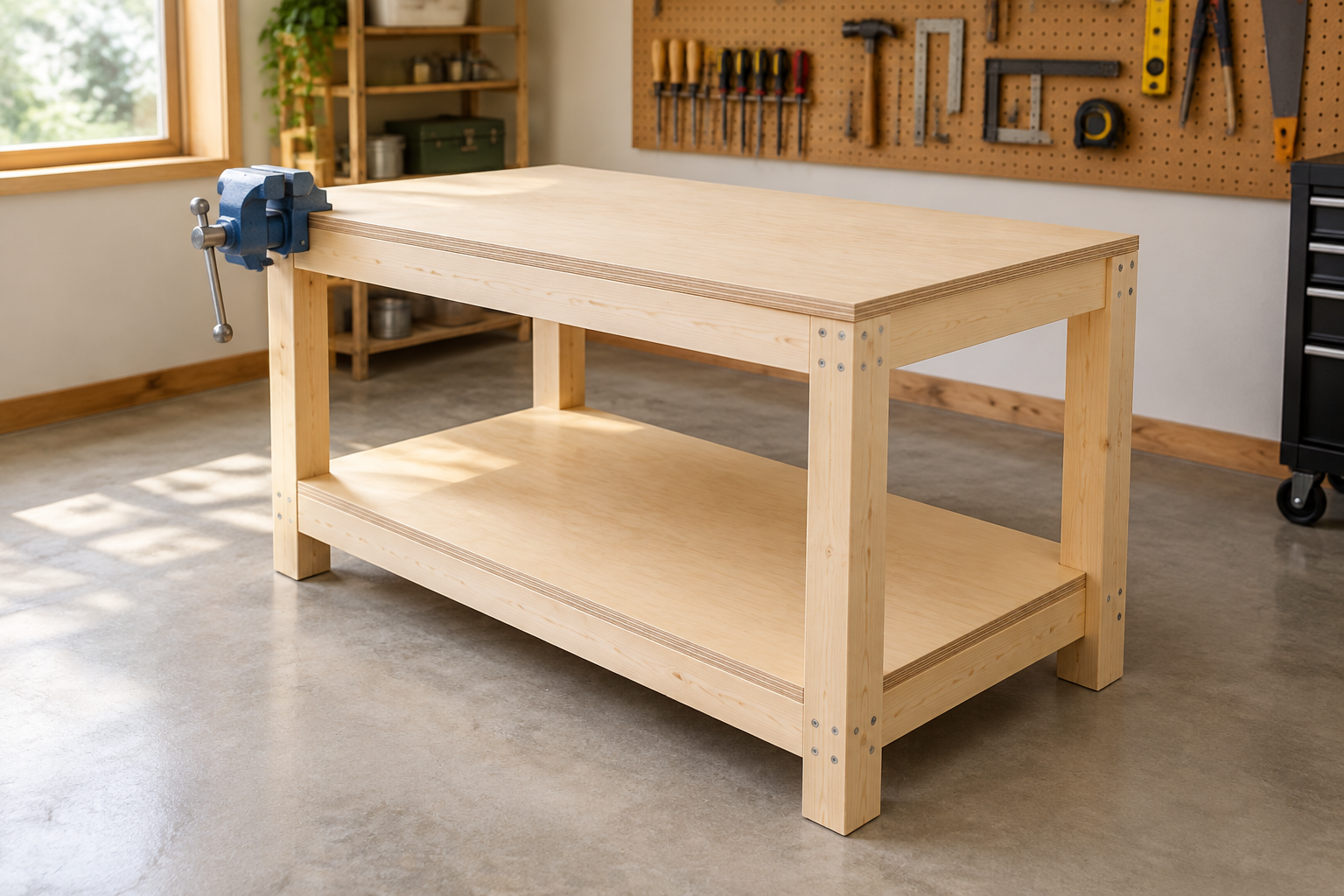
Garage workbench
1397 mm × 876.3 mm × 914.4 mm · top 19.05 mm
0%
Cut list
| Part | Qty | L × W × T (mm) | Note |
|---|---|---|---|
| Leg | 4 | 895.35 × 88.9 × 38.1 | 2×4, vertical |
| Long apron | 4 | 1320.8 × 88.9 × 38.1 | top + shelf frame, front/back |
| End apron | 4 | 698.5 × 88.9 × 38.1 | top + shelf frame, ends |
| Shelf support | 1 | 800.1 × 88.9 × 38.1 | center, under shelf |
| Top | 1 | 1397 × 876.3 × 19.05 | plywood |
| Shelf | 1 | 1320.8 × 876.3 × 19.05 | rests on lower frame |
| Wood screw 63.5 mm | 36 | 63.5 × 4.2 × 4.2 | framing, 2 per joint (18 joints) + glue |
| Wood screw 41.27 mm | 35 | 41.27 × 4.2 × 4.2 | top + shelf |
About this plan
A stout garage workbench from construction 2×4s and 3/4 in plywood: four legs inside a double apron frame, a plywood top at counter height, and a lower shelf frame that carries a full second sheet of storage. Every framing joint is glued and fixed with two 2-1/2 in screws — driven through the leg into the long aprons, toe-screwed where the end aprons meet the legs — so there are no pocket holes and no special joinery.
Enter your length, depth, and height and the model, cut list, and screw counts rebuild around them. Tops run to 2 m on four legs; the configuration link always reproduces exactly what you see.
Questions
- What lumber should I buy?
- Standard construction-grade 2×4 studs (actual 1-1/2 × 3-1/2 in) and 3/4 in plywood such as AC or BC pine — two 4×8 sheets at the default size, since the top and shelf don't both fit on one. Straight, dry studs matter more than species.
- What screws do I need?
- 2-1/2 in #8 wood screws with glue for all framing joints, 1-5/8 in screws for the plywood top and shelf. The live cut list above counts both for your exact size.
- Do I need pocket holes?
- No. The long aprons butt the inside face of each leg and take two 2-1/2 in screws driven through the leg into the apron end. The end aprons butt the edge of the leg, which is too deep to screw through, so drive two 2-1/2 in screws at an angle (toe-screw) through the apron face into the leg. A drill/driver is the only boring tool required.
- How heavy a load can it take?
- The 2×4 apron frame around all four sides keeps the top flat under typical garage loads — vises, engines, full paint cans — and the center support under the shelf stops the lower shelf sagging. Keep extreme point loads over the legs.
- Can I make it longer than 2 m?
- The configurator tops out at 2 m on four legs. Beyond that, build two benches and bolt them together, or add your own center leg pair under the long aprons.