 Free plan
Modern 2x6 bench
1219.2 mm × 495.3 mm × 876.3 mm
Cut list
| Part | Qty | L × W × T (mm) | Note |
|---|---|---|---|
| A — rear leg — 2x6 | 2 | 876.3 × 139.7 × 38.1 | Cut two rear uprights 876.3 mm long. Their 139.7 mm breadth runs across the bench, with 38.1 mm thickness front to back. Keep feet on the same plane as the front legs and lower rails. Rear leg forward faces sit 457.2 mm behind the front edge. All stock is actual 139.7 mm × 38.1 mm; check before cutting. Cuts exclude kerf and trimming waste. |
| B — front leg — 2x6 | 2 | 419.1 × 139.7 × 38.1 | Cut two 419.1 mm front legs. Each caps the forward ends of its upper and lower rails. Upper rail tops are flush with front leg tops; the seat then finishes at 457.2 mm above the floor. Square both side frames before attaching the seat. |
| C — horizontal side rail — 2x6 | 4 | 419.1 × 139.7 × 38.1 | Cut four rails 419.1 mm long, two per side. Lay them flat, 38.1 mm high and 139.7 mm across the bench. Butt their ends between the front and rear legs: lower rail bottoms at floor level, upper rail tops at 419.1 mm. The source uses three 69.85 mm screws per rail/leg joint. Gap changes alter these lengths, not the front leg lengths. Select exterior screws suitable for these end-grain joints and drill as their manufacturer requires. |
| D — seat / back board — 2x6 | 5 | 1219.2 × 139.7 × 38.1 | Cut five boards 1219.2 mm long without ripping their 139.7 mm breadth. Fit three flat on the side frames with 19.05 mm gaps, ends flush with frame outer faces, front edge flush with front legs and rear edge at the rear leg forward faces. Fit two upright against those rear leg faces; upper board top flush at 876.3 mm, lower board separated by 19.05 mm. Source fastening: two 69.85 mm screws per board/support contact, about 50 screws total as a shopping allowance, not a load specification. Keep boards separate; allow seasonal movement and drainage. Fasteners and holes are not rendered. Two 1219.2 mm cuts need 2438.4 mm, which leaves no room for kerf in an 8-foot (2438.4 mm) board; cut one per board or buy longer stock. |
About this plan
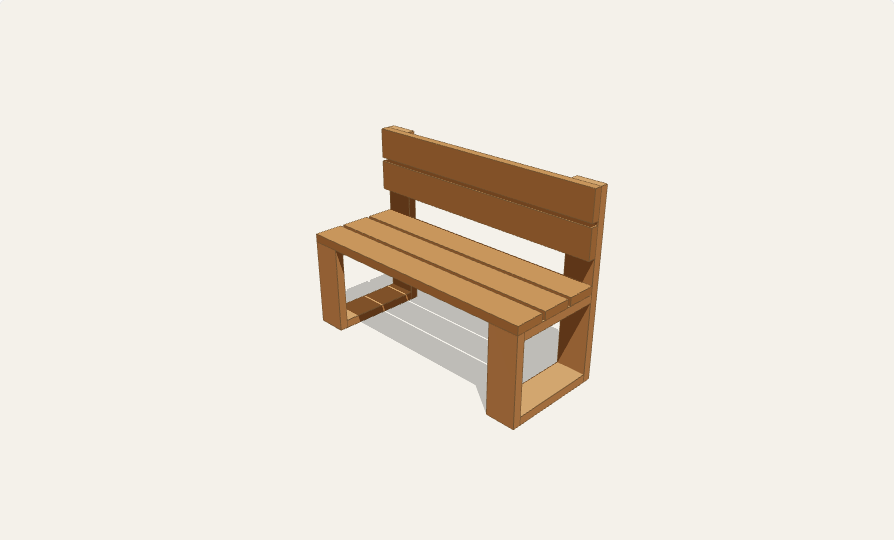
Thirteen square-cut 2x6 pieces make this outdoor bench: two 419.1 mm front legs, two 876.3 mm rear legs, four horizontal side rails, three seat boards and two back boards. Each side frame has upper and lower rails butted between its front and rear legs. The seat boards lie flat across the frames, flush at the front and ending at the rear legs' forward faces. The back boards stand upright against those faces, with the top board flush with the rear-leg tops. This independently modeled adaptation follows Ana White's modern bench construction; consult the linked source for its illustrated assembly sequence.
Customize the finished width from 1000–1600 mm and the slat gap from 3–19.05 mm. Defaults: 1219.2 mm wide, 495.3 mm deep, 876.3 mm tall, with the seat top at 457.2 mm. The gap sizes the seat depth (3 × 139.7 mm boards plus two gaps), so it changes the four side-rail cut lengths and the overall depth while the 139.7 mm board breadth and 38.1 mm thickness never change — no board is ripped narrower. The default 19.05 mm gap is inferred: three boards plus two such gaps give the source's full 18-inch seat depth with the front edge flush and the rear edge on the rear-leg faces. The source's screws (about fifty 69.85 mm self-tapping exterior screws) are a shopping allowance, not inventoried. No CNC export; the customization ranges are not certified spans, no load rating is claimed, and two 1219.2 mm cuts use a full 2438.4 mm board, so saw kerf means extra or longer stock beyond five 8-foot boards.
Questions
- Which dimensions can I customize?
- Width runs 1000–1600 mm and the slat gap 3–19.05 mm. Width changes the five full-width board lengths; the gap changes the seat depth (3 × 139.7 mm plus two gaps), so it resizes the four side-rail cuts and the overall depth. The 419.1 mm front legs, 876.3 mm rear legs, 457.2 mm seat height and 139.7 mm board breadth stay fixed — no slat is ever ripped narrower. These bounds are customization limits, not certified spans.
- Why is the default gap 19.05 mm when the source doesn't label one?
- The source does not label a gap. Its frame geometry gives 457.2 mm (18 inches) from the front edge to the rear legs' forward faces. Three 139.7 mm seat boards leave 38.1 mm to divide between two gaps, giving 19.05 mm each. This adaptation uses that inferred spacing for the seat and between the two back boards. Changing the gap also changes the four side-rail lengths so the seat still fits the frame.
- Is it glued or screwed?
- The source specifies 69.85 mm (2¾-inch) self-tapping wood screws: three per frame joint and two per board/support contact. About 50 is its shopping estimate, not an exact generated hardware inventory or a load specification. Choose screws suitable for the exposure and joints, and drill as their manufacturer requires. Hardware and holes are not rendered; glue is not specified for this adaptation.
- Do five 8-foot 2x6s really suffice?
- Five 8-foot boards are the source's shopping allowance, not a stock-yield guarantee. An 8-foot board is 2438.4 mm, so two full-width cuts fit one board only when the bench is narrower than 1219.2 mm, with the remainder covering kerf and trimming. At the default 1219.2 mm width two cuts consume the entire board before any kerf, and wider benches need one board per full-width cut, so extra or longer stock is needed. The cut-list note shows the margin for your width. Measure and plan cuts before buying. No load rating is established; use on firm, level ground with sound joints, not as a step or ladder.